Learning and development is under pressure in many organizations. Leaders want faster results, employees are stretched, and anything that feels too theoretical is often the first thing to be sacrificed. The truth is simple: when learning is grounded in strong thinking and tied directly to real work, it becomes a competitive advantage.
In one organization, 50 managers completed a leadership program and rated it 4.8 out of 5. Six months later, nothing had changed in how decisions were made or how teams operated. In another, managers spent just two hours a week working on real business problems with coaching. Within three months, they reduced approval bottlenecks and improved delivery speed without any formal training program.
Why Theory Still Matters
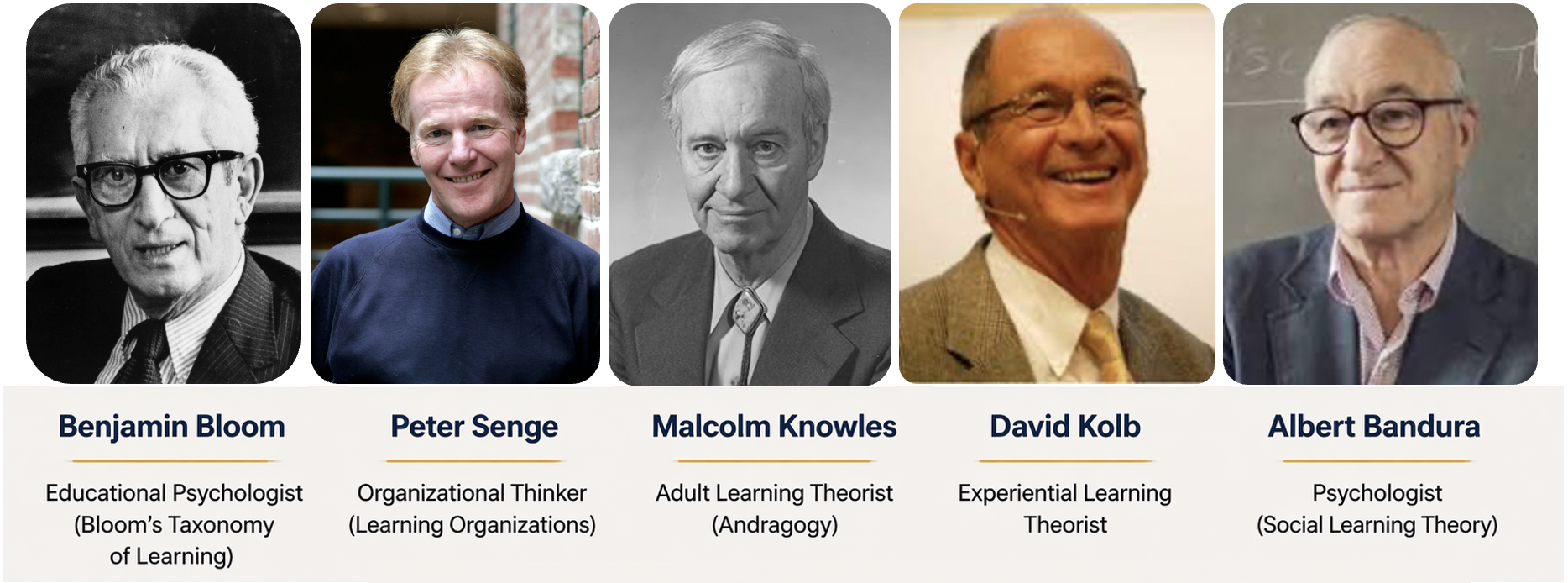
This is where the ideas of Bloom, Senge, Knowles, Kolb, and Bandura still matter. They were not writing for the sake of academic debate, they were trying to understand how people actually learn, grow, and change in complex environments such as the workplace.
Bloom’s taxonomy reminds us that learning should go beyond remembering information. The real value appears when people can Apply, Analyze, Evaluate, and Create in the context of their jobs. Senge’s work on the learning organization shows that businesses that make learning part of how they operate are better positioned to Adapt, Innovate, and Execute. In fast-moving markets, that matters more than ever.
Knowles, Kolb, and Bandura all point in a similar direction: adults learn best when learning is relevant, practical, and connected to experience, reflection, and peer Support. In other words, people learn most effectively when the learning helps them do their jobs better. In practice, this might mean replacing a full-day leadership workshop with a 2-week sprint where managers work on an actual business challenge, receive coaching, and reflect on what worked and what didn’t.
For learning professionals, familiarity with these theories is not academic decoration. It helps you diagnose what is really needed, choose the right design, avoid one-size-fits-all solutions, and explain to leaders why a particular approach is more likely to work. It also gives you a clearer way to assess impact, because theory helps define what success should look like at each stage of learning, not just whether people showed up or enjoyed the session.
That matters because training can look successful when it is really only producing attendance, engagement, or satisfaction. Without a clear theory of how learning should change behavior and performance, L&D risks creating polished programs that do not deliver real business impact. This is not a new challenge. Research on learning transfer consistently shows that a large portion of training never translates into workplace behavior. The gap between what is learned and what is applied remains one of the biggest issues in L&D.
Two recent peer-reviewed studies speak directly to this very topic. A 2025 systematic scoping review in the Journal of Workplace Learning examines evaluation tools for training transfer, confirming the persistent gap between training sessions and on-the-job application without contextual reinforcement. Likewise, a 2023 meta-analysis in the Journal of Occupational and Organizational Psychology shows workplace coaching yields moderate to strong positive effects on performance and behavior when tied to real work, outperforming standalone training.
The cautionary tale is that theory is only useful when it guides action. If learning professionals rely on theory too heavily, they can create elegant programs that look intelligent but are hard to apply, difficult to measure, and disconnected from the realities of the business.
What this means for organizations:
Focus learning on the capabilities that directly support strategic priorities e.g., building commercial acumen in frontline managers rather than generic leadership skills
Move beyond one-off workshops and into shorter, practical learning cycles built around real work e.g., replacing a 2-day course with weekly 60-minute problem-solving sessions
Turn managers and subject-matter experts into capability builders, not just reviewers e.g., equipping managers with simple coaching questions they use in weekly check-ins
Create habits like reflection, team learning, and after-action reviews that reinforce learning over time e.g., short after-action reviews after major projects or client interactions
Theory is not a distraction from performance. Used well, it helps you decide what to stop doing as much as what to start doing. It pushes learning away from content for its own sake and toward targeted, embedded, high-impact development.